As governments tighten plastic regulations and consumers increasingly demand environmentally responsible products, the global food packaging industry is undergoing a fundamental transformation. Single-use plastic and foam containers are rapidly being phased out, while fiber-based, compostable alternatives are becoming the new industry standard. Among all available materials, bagasse—sugarcane fiber—has emerged as the most commercially viable and environmentally effective solution.
1. Global Plastic Ban Policies Are Accelerating Market Transformation
Over the past decade, plastic reduction has evolved from voluntary initiatives into mandatory legislation across major economies:
European Union Single-Use Plastics Directive (SUP) requires the elimination of many disposable plastic food-service products and mandates sustainable alternatives.
North America, including Canada and multiple U.S. states such as California and New York, has enacted phased bans on foam containers and plastic tableware.
Asia-Pacific regions, including Japan, South Korea, Taiwan, and India, are introducing strict packaging sustainability targets.
Australia and New Zealand have implemented nationwide restrictions on polystyrene food packaging.
These regulations are reshaping procurement standards for food service operators, retailers, and brand owners. Companies that fail to transition away from plastic risk regulatory penalties, lost contracts, and reputational damage.
2. The Rapid Rise of Biodegradable and Compostable Tableware
Policy pressure is only part of the equation. Market demand is being equally driven by consumer behavior and corporate sustainability commitments:
Consumers are increasingly willing to pay a premium for eco-friendly food packaging.
Global food chains and retailers are publicly committing to plastic-free packaging roadmaps.
ESG compliance and Life Cycle Assessment (LCA) metrics are now critical in supplier selection.
Institutional buyers, airlines, hotels, and catering groups prioritize certified compostable products.
As a result, the global market for biodegradable food service packaging is expanding at a strong and consistent pace, while traditional plastic packaging continues to decline.
3. Why Bagasse Outperforms Other Sustainable Materials
Bagasse is the fibrous residue left after sugar extraction, making it an abundant, renewable, and low-impact raw material. Its advantages are both environmental and commercial:
✔ Fully Biodegradable and Compostable
Bagasse tableware decomposes naturally under industrial composting conditions without releasing microplastics or toxic residues.
✔ Renewable and Low-Carbon
As an agricultural byproduct, bagasse does not require additional land or deforestation. Its carbon footprint is significantly lower than petroleum-based plastics and even traditional paper pulp.
✔ Superior Functional Performance
Heat-pressed bagasse tableware offers excellent strength, heat resistance, oil resistance, and structural stability—ideal for hot meals, greasy foods, and liquid applications.
✔ Globally Recognized Certification Compatibility
Bagasse products can comply with major international standards such as EN13432, BPI, and OK Compost, enabling access to global export markets.
4. Key Drivers Behind Growing Market Demand
1️⃣ Regulatory Compliance as a Market Necessity
Mandatory plastic bans force food service operators and packaging suppliers to adopt compliant materials, creating long-term, non-optional demand.
2️⃣ Brand Sustainability and Competitive Differentiation
Eco-friendly packaging has become a branding asset. Businesses that adopt bagasse-based solutions strengthen their ESG positioning and gain consumer trust.
3️⃣ Supply Chain Localization and Cost Control
Rising logistics costs and unstable global supply chains are encouraging companies to invest in local bagasse tableware production lines, ensuring stable supply and predictable costs.
Conclusion: Bagasse Is Becoming the Global Standard
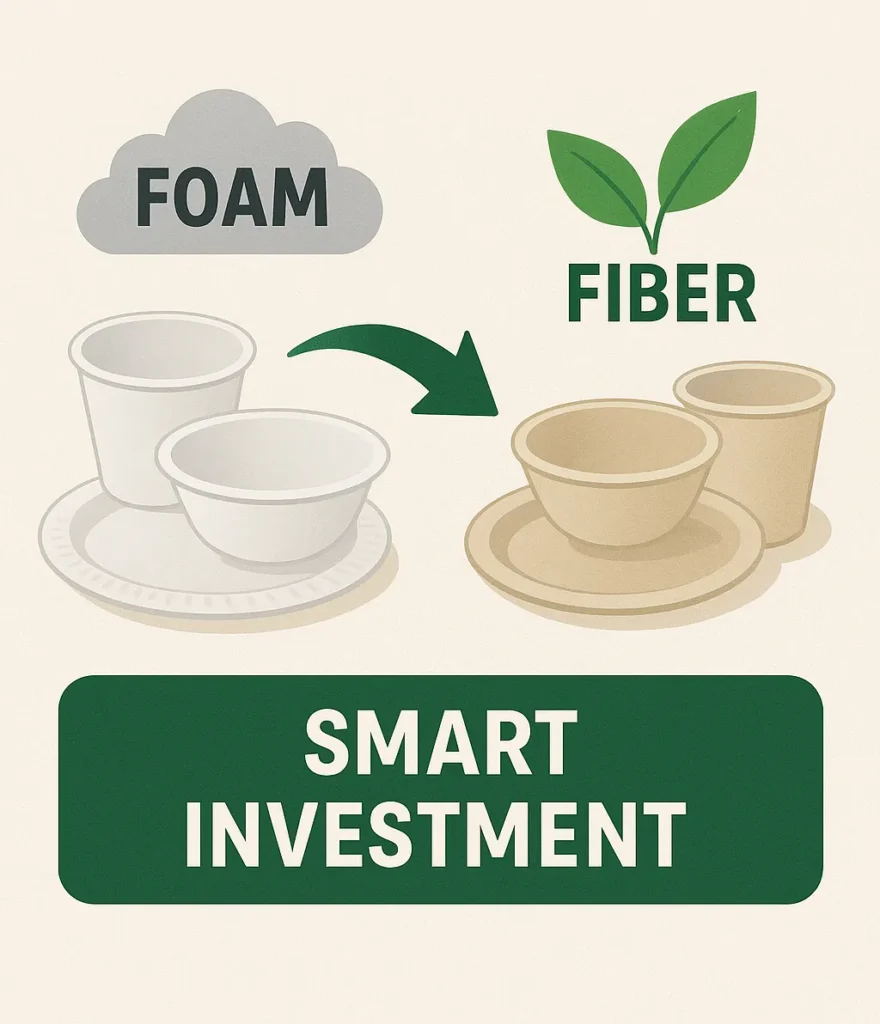
The transition from foam to fiber is no longer optional—it is inevitable. Driven by regulation, consumer awareness, and corporate sustainability goals, bagasse-based food packaging is fast becoming the global benchmark for disposable tableware.
For forward-thinking businesses, investing in a bagasse tableware production line today means securing compliance, capturing market share, and building long-term profitability in a sustainability-driven global economy.