
Walk into a mid-to-large scale molded fiber factory and the line most likely producing precision packaging — as opposed to basic egg trays — is a multi-face mold punching pulp molding machine. It’s one of the more specialized configurations in the pulp molding industry, and it’s frequently confused with standard rotary or reciprocating machines because the forming stage looks similar. The difference shows up later in the process, in how the product is trimmed and finished.
The Core Definition
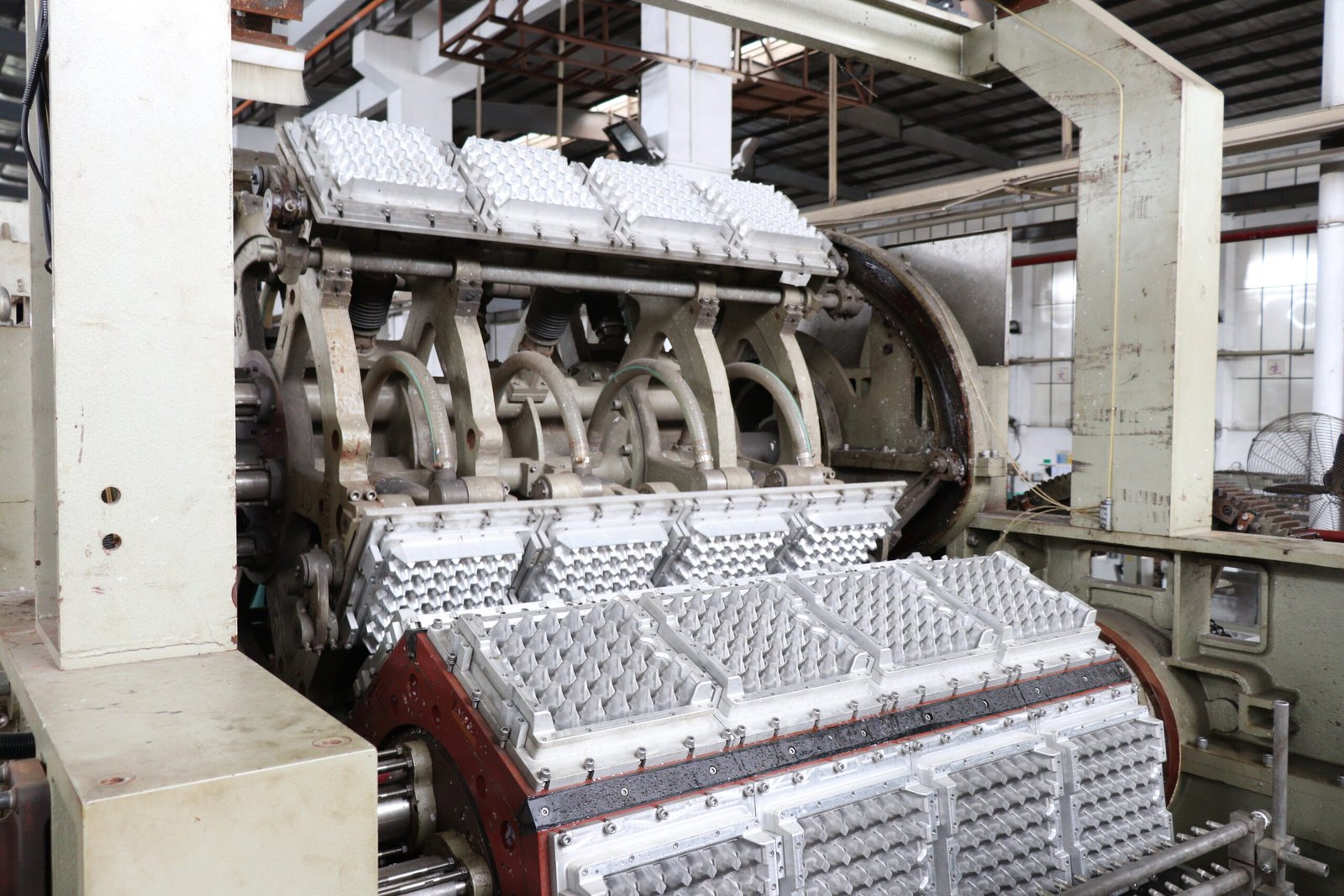
A multi-face mold punching pulp molding machine is a type of pulp molding equipment that combines fiber forming with an integrated punching (die-cutting) station, and does so across multiple mold faces mounted on a single rotating or indexing drum. Instead of forming a tray and sending it downstream for a separate trimming step, the punching unit trims, perforates, or cuts the wet or semi-dry fiber product in-line, immediately after forming, while it’s still mounted on the mold.
“Multi-face” refers to the number of mold sets fixed around the drum or platen — commonly four, six, or eight faces — each cycling through the forming, transfer, and punching sequence in rotation. More faces per cycle generally means higher output per hour, since multiple molds are being filled, drained, and punched simultaneously rather than one at a time.
This design sits between the two more familiar categories of pulp molding equipment:
- Reciprocating (movement-type) machines — pulp suction and transfer move back and forth on a linear frame; simpler, lower cost, but slower and with limited punching integration.
- Rotary machines — a rotating cylinder cycles through multiple mold sets continuously; higher output, but traditionally built for smooth-edge products like egg trays that don’t need precision cutting.
The multi-face punching type borrows the multi-mold throughput advantage of rotary designs and adds the die-cutting capability that reciprocating lines sometimes include only as a secondary offline process.
Why the Punching Step Matters
Plain vacuum-formed fiber packaging comes off the mold with rounded, slightly irregular edges — fine for an egg tray, where the product just needs to hold eggs without piercing them. But industrial and protective packaging — electronics trays, wine bottle inserts, medical device packaging, precision molded pulp trays for automotive parts — often needs:
- Clean, dimensionally accurate edges to fit into corrugated outer boxes without gaps
- Cut-outs, slots, or holes for parts to sit in specific orientations
- Consistent wall thickness at the cut line, which affects how well the tray nests and stacks
A separate offline trimming station can achieve this, but it adds a production step, extra handling (which raises breakage risk on semi-dry fiber product), and floor space. Building the punching function directly into the mold face means the product is cut to final dimension in the same motion that forms and releases it, before it moves to drying.

How the Process Sequence Works
A typical cycle on a multi-face mold punching machine follows this sequence for each mold face as it rotates or indexes through the stations:
- Pulp suction (forming) — the mold face is submerged or exposed to pulp slurry under vacuum, drawing fiber onto the mold surface to build the product shape.
- Pre-dewatering — vacuum continues to pull excess water out while the mold is still in position, raising the fiber solids content before transfer.
- Transfer — a secondary transfer mold (often under reverse air pressure) lifts the semi-formed product off the forming mold and carries it toward the punching/finishing station.
- Punching — the integrated die cuts the product to final edge profile, and/or punches functional holes, slots, or perforations, while the fiber is still pliable enough to cut cleanly but firm enough to hold its shape.
- Release and transport — the finished wet product is released onto a conveyor or drying tray rack, and the mold face returns to the pulping tank to begin the next cycle.
Because several mold faces are active at different stages of this sequence at the same time, the machine achieves continuous output rather than a stop-start cycle — this is the main throughput advantage over a single-mold reciprocating punching setup.
Typical Applications
Multi-face mold punching pulp molding machines are generally specified for products where dimensional precision at the edge matters more than raw speed, including:
- Industrial protective packaging (electronics, small appliances, automotive components)
- Molded fiber trays with cut slots for wine or spirits bottles
- Medical and pharmaceutical device trays requiring precise cavity shapes
- High-end egg cartons and specialty food packaging where a clean punched edge improves stacking and shelf presentation
Standard commodity egg trays — the flat 30-cell type most common in supermarkets — usually don’t require this equipment, since a simpler rotary machine without integrated punching is cheaper to run for that application. Buyers evaluating equipment for pure egg tray production should weigh whether the punching capability is actually needed for their product line, since it adds cost and mechanical complexity that isn’t recovered unless the end product benefits from precision trimming.
Key Specification Points to Compare
When comparing machines from different manufacturers, a few specification points tend to reveal more about real-world performance than the headline capacity figure:
- Number of mold faces and cycle time — output is a function of both, not faces alone; a machine with more faces but a slower cycle may not outperform a leaner design.
- Punching die material and replacement interval — punching dies wear faster than forming molds because they’re doing mechanical cutting work on a semi-abrasive fiber material; die steel grade and expected service life should be part of any quote comparison.
- Alignment tolerance between forming and punching stations — if the transfer between forming mold and punching die isn’t precisely aligned, edge quality suffers and reject rates climb; this is one of the harder things to evaluate from a spec sheet alone and is best judged from a factory trial run using the buyer’s own product design.
- Scrap fiber handling — punching generates offcut fiber waste that needs to be reclaimed back into the pulping system; machines that don’t handle this cleanly create ongoing housekeeping and material-loss problems.
Where It Fits in a Buying Decision
For a manufacturer producing only basic, smooth-edge fiber packaging, a multi-face mold punching machine is generally more equipment than the product requires. For a manufacturer targeting industrial, medical, or precision food/beverage packaging where the finished part needs a defined, accurate edge or functional cutouts, the integrated punching capability removes a production step and reduces handling damage compared with forming and trimming as separate processes.
As with any pulp molding equipment purchase, the safest way to validate a specific machine’s suitability is a trial run using the buyer’s actual mold design and target material mix, since punching performance in particular depends heavily on fiber composition, moisture timing, and die condition — variables that don’t always show up clearly in a written specification.