Egg Carton Fiber Forming Equipment — Quick Answer Summary
Egg carton fiber forming equipment is a pulp molding machine that converts recycled paper or plant fiber into molded egg trays and cartons. The process involves four main stages: pulp preparation (mixing waste paper with water), vacuum forming (shaping pulp onto metal molds using suction), drying (conveyor or brick drying), and hot pressing (optional finishing step for smooth surfaces).
The main components of egg carton fiber forming equipment include: a hydrapulper (pulp beater), a pulp storage tank, a forming machine with rotating mold drum, a vacuum pump system, a conveyor drying system or brick drying tunnel, and a hot press unit.
Types of egg carton forming machines: (1) Rotary drum forming machine — high capacity, fully automatic, up to 6,000+ trays/hour; (2) Reciprocating forming machine — semi-automatic, 1,000–2,000 trays/hour, lower cost; (3) Four-sided forming machine — medium capacity, suitable for diverse product shapes.
Raw materials used: waste newspaper, old cardboard, office paper, sugarcane bagasse, wheat straw. Water consumption: approximately 1 cubic meter of water per 100 kg of pulp. Energy: electric power plus drying fuel (natural gas, diesel, or biomass).
Key selection factors: daily production capacity target, available raw materials, drying method (natural vs. industrial), automation level, available budget (range: $15,000–$500,000+ USD depending on scale).
What Is Egg Carton Fiber Forming Equipment?
Egg carton fiber forming equipment — also called a pulp molding machine or egg tray forming machine — is an industrial system that converts recycled paper pulp or natural plant fiber into molded packaging products, most commonly egg cartons, egg trays, and fruit trays.
The technology belongs to the broader category of pulp molding, which is recognized globally as one of the most environmentally sustainable packaging manufacturing methods. Products made on these machines are fully biodegradable, compostable, and produced from post-consumer waste.
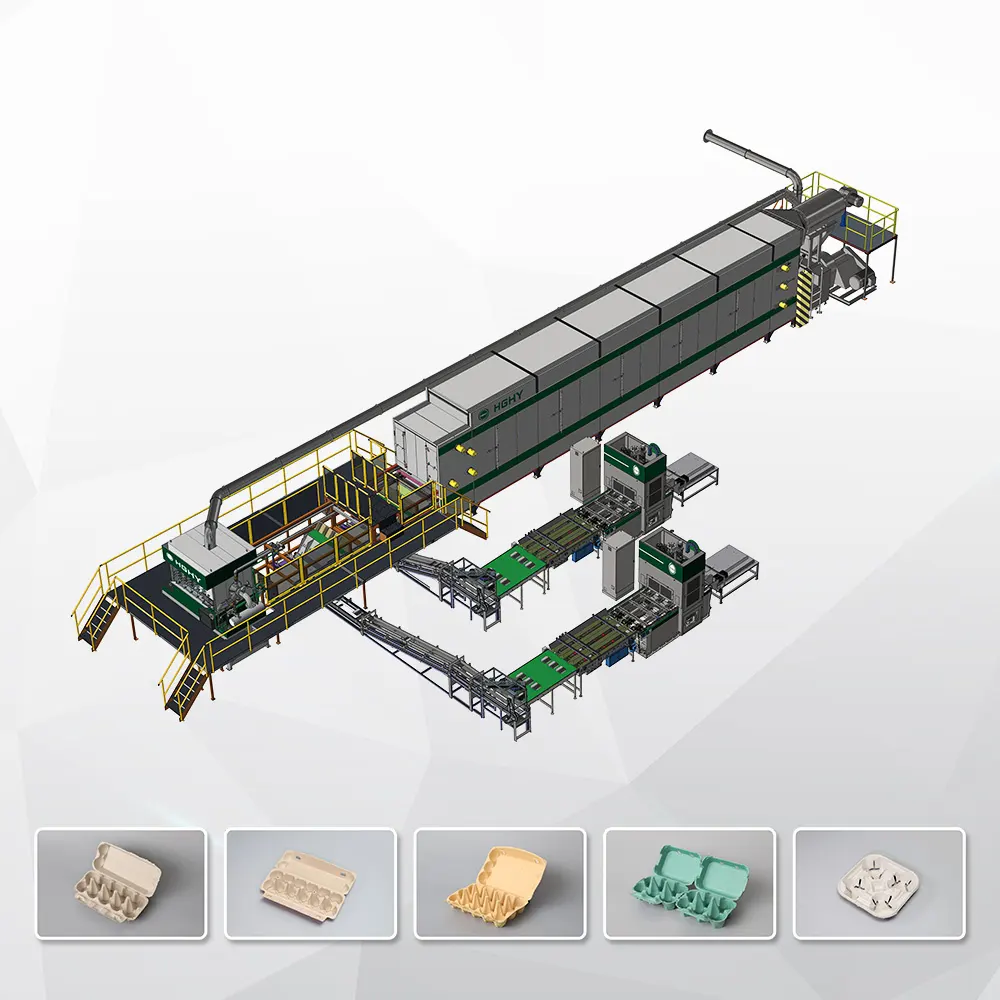 Automatic In-Line Hotpress Egg Carton Machine — a fully integrated fiber forming line combining vacuum forming, conveyor drying, and hot pressing in one system.
View Product Details →
Automatic In-Line Hotpress Egg Carton Machine — a fully integrated fiber forming line combining vacuum forming, conveyor drying, and hot pressing in one system.
View Product Details →
Eco-Friendly Output
100% biodegradable and compostable products made from recycled fiber — a direct alternative to plastic packaging.
Wide Product Range
Beyond egg cartons, the same equipment can produce fruit trays, bottle holders, industrial cushioning, and seedling cups.
Scalable Production
Available from small semi-automatic lines (500 trays/hr) to fully automatic systems exceeding 6,000 trays/hr.
How Does Egg Carton Fiber Forming Equipment Work?
The production process follows a clear sequential flow. Understanding each stage helps buyers evaluate equipment quality and select the right configuration for their needs.
Pulp Preparation
Waste paper (newspapers, cardboard, office paper) is soaked in water and fed into a hydrapulper (pulp beater). The machine breaks the material into a uniform fiber slurry, typically at a concentration of 0.5%–1.5%. The pulp is then screened to remove impurities and stored in a holding tank.
Vacuum Forming
The pulp slurry is fed into the forming machine, where vacuum suction draws the fiber onto metal mold surfaces shaped like egg carton cavities. As water is sucked through the mold, a wet fiber layer builds up — this becomes the raw egg carton shape. The mold then transfers the wet product onto a drying carrier.
Drying
The wet-formed products are dried to reduce moisture content to below 12%. Two drying methods are common: brick tunnel drying (lower cost, uses natural gas or biomass) and metal conveyor drying (faster, more automated, preferred for high-volume lines). Drying is typically the most energy-intensive stage.
Hot Pressing (Optional)
For premium egg cartons requiring a smooth, uniform surface, a hot press unit applies heat and pressure to the dried product. This step improves appearance, reduces dust shedding, and adds structural rigidity. It is optional for standard egg trays but recommended for retail-grade cartons.
Counting, Stacking & Packing
Finished egg cartons are automatically counted, stacked, and bundled for shipment. Fully automated lines integrate robotic stacking and conveyor systems at this stage.
Key Components of Fiber Forming Equipment
A complete egg carton production line consists of several interconnected systems. Each plays a specific role in production efficiency and product quality.
1. Hydrapulper (Pulp Beater)
The hydrapulper is the starting point. It uses high-speed rotating blades to break down waste paper in water. A well-designed hydrapulper ensures consistent fiber length and slurry uniformity, which directly impacts the structural strength of the finished egg carton.
2. Pulp Storage & Mixing Tank
After beating, the pulp is stored in agitated tanks to maintain uniform concentration and prevent fiber settlement. Additives such as colorants or water-resistance agents can be introduced here.
3. Forming Machine with Mold Drum
This is the heart of the system. The forming machine holds rotating molds — the shape of the egg carton is defined by these precision-engineered aluminum or copper molds. The mold drum rotates through the pulp tank, with vacuum drawing fiber onto each mold cavity.
4. Vacuum Pump System
The vacuum system provides the suction force needed to pull fiber onto the molds and remove excess water. Vacuum pump capacity (measured in m³/min) determines forming speed and is a critical specification when comparing machines.
5. Conveyor Drying System
Metal mesh conveyor belts carry wet-formed products through a heated drying tunnel. Temperature, belt speed, and tunnel length are engineered to achieve target moisture content. Multi-layer conveyor systems are used in high-capacity lines to maximize throughput with a compact footprint.
6. Hot Press Unit
Operates at temperatures of 150–200°C. The upper mold (heated) presses down on the dried product resting on the lower mold, producing a smooth, compact finish. Hot-pressed egg cartons are preferred in supermarket retail due to their clean appearance.
Molds are a long-term investment. High-quality machined aluminum molds (CNC-milled) offer dimensional precision and a service life of 3–5 years. Lower-cost cast molds may require more frequent replacement and produce less consistent products.
Types of Egg Carton Fiber Forming Machines
There are three main forming machine configurations used in the industry today, each suited to different production scales and budgets.
Rotary Drum Forming Machine
The most widely used type for high-volume production. The forming molds are mounted on a multi-sided rotating drum (typically 8–16 sides). As the drum rotates, molds pass through the pulp tank (forming) and transfer position (product transfer) continuously. Rotary machines are fully automatic, require minimal labor per unit of output, and can achieve output rates of 3,000–7,000+ trays per hour.
Reciprocating (Flip) Forming Machine
Uses a reciprocating motion — the mold descends into the pulp tank, forms product, then flips to transfer the wet product to a dryer carrier. This type is simpler in design, lower in initial cost, and more suitable for small-to-medium production volumes (500–2,500 trays/hour). It is a popular entry-level choice for new businesses.
Four-Sided (Rotary Table) Forming Machine
A middle-ground option that rotates a square or four-sided turntable through forming, transfer, cleaning, and standby positions. Offers more flexibility for producing different tray sizes and shapes compared to drum machines, at a moderate cost.
Raw Materials Used in Egg Carton Fiber Forming
The choice of raw material directly impacts product color, strength, and cost. The most common input materials are:
- Waste newspaper — Most widely used. Low cost, available in large quantities, produces light gray to white egg trays.
- Old corrugated cardboard (OCC) — Longer fibers, produces stronger and heavier trays. Preferred for industrial egg trays used in large farms.
- Office paper / white ledger — Produces cleaner, whiter output suitable for retail cartons. Higher cost.
- Sugarcane bagasse — Agricultural byproduct with excellent fiber properties. Ideal in sugarcane-producing regions (Southeast Asia, South America). Produces a distinctive natural-brown carton.
- Wheat / rice straw — Another agricultural fiber option. Requires more processing due to shorter fiber length but reduces dependency on paper waste.
Most fiber forming equipment is designed to process multiple fiber types with adjustments to pulp concentration and beating time.
Capacity & Specification Comparison
The table below compares typical specifications across common machine types and scales to help buyers benchmark their requirements.
| Machine Type | Capacity (trays/hr) | Automation | Drying Method | Approx. Price Range |
|---|---|---|---|---|
| Semi-Auto Reciprocating | 500–1,500 | Semi-automatic | Brick tunnel (manual transfer) | $15,000–$60,000 |
| Auto Reciprocating | 1,500–2,500 | Automatic | Brick or conveyor | $60,000–$150,000 |
| Four-Sided Rotary | 2,000–4,000 | Fully automatic | Metal conveyor | $100,000–$250,000 |
| Rotary Drum (8-side) | 3,000–5,000 | Fully automatic | Metal conveyor | $150,000–$350,000 |
| Rotary Drum (12–16 side) | 5,000–7,000+ | Fully automatic | Metal conveyor (multi-layer) | $300,000–$600,000+ |
* Prices are indicative and vary by manufacturer, configuration, and market. Always request formal quotations.
How to Choose the Right Egg Carton Fiber Forming Equipment
Selecting the right machine is a critical business decision. Consider the following factors systematically:
1. Daily Production Target
Work backwards from your sales volume or market demand. If you need to produce 500,000 egg cartons per day, a machine with 3,000 trays/hour operating 16 hours/day may be sufficient — but you should also factor in downtime, maintenance windows, and growth buffer.
2. Available Raw Material
Assess the local availability and cost of waste paper or agricultural fiber. If your region has abundant sugarcane bagasse, equipment configured for agricultural fiber may offer a significant cost advantage. If waste paper is plentiful, a standard pulp molding line is the simpler choice.
3. Drying Method
In regions with abundant sunlight and low labor costs, natural sun drying (no industrial dryer) can reduce capital investment significantly, though it limits output and quality consistency. Industrial drying (brick tunnel or metal conveyor) is recommended for consistent, year-round, high-volume production.
4. Target Product Quality
If your customers are large supermarkets or export markets, hot-pressed, smooth-finish cartons will command higher prices and justify the additional investment in a hot press unit. If you supply poultry farms directly, standard dried trays without hot pressing are typically acceptable.
5. Manufacturer Support & After-Sales Service
For buyers outside of China (where most equipment is manufactured), evaluate the supplier's ability to provide remote technical support, spare parts supply, and on-site installation assistance. Request references from existing clients in similar markets.
Before committing to a purchase, ask the manufacturer to run a trial using your specific raw material (e.g., local waste paper or bagasse) and produce sample cartons for your quality review. Reputable manufacturers will accommodate this request.
Frequently Asked Questions
Egg carton fiber forming equipment is a type of pulp molding machine that converts recycled paper or plant fiber (such as sugarcane bagasse) into eco-friendly egg cartons and trays. The process includes pulp preparation, vacuum forming, drying, and optional hot pressing.
The equipment soaks waste paper in water to create a pulp slurry. Vacuum suction then draws the fiber onto shaped metal molds, forming the egg carton shape. The wet product is transferred to a drying system and optionally hot-pressed for a smooth finish.
Capacity ranges from about 500 trays/hour for small semi-automatic reciprocating machines to over 7,000 trays/hour for large fully automatic rotary drum systems. The right capacity depends on your target daily output and available budget.
The most common raw materials are waste newspaper, old corrugated cardboard, office paper, sugarcane bagasse, and wheat or rice straw. Most equipment can handle multiple fiber types with minor process adjustments.
Prices range from approximately $15,000–$60,000 for basic semi-automatic lines to $300,000–$600,000+ for large fully automatic systems with multi-layer conveyor dryers. The total investment also includes installation, molds, and utilities setup.
Yes. Pulp-molded egg cartons are made from recycled fiber, are 100% biodegradable and compostable, and require significantly less energy to produce than plastic or polystyrene alternatives. The industry is considered a key part of the circular economy for packaging.