
Large regional egg distributors should evaluate an integrated, high-speed HGHY Double Rotary Egg Tray Production Line when their priority is dependable, high-volume production of standard egg trays and related pulp-molded packaging. The best configuration is not defined by forming speed alone. It must balance pulp preparation, forming, drying, transfer, stacking, mold availability, utilities, and service support around the distributor’s actual daily dispatch schedule.
For operations supplying multiple packing stations, wholesale routes, or regional retail accounts, the goal is simple: produce enough consistent trays to prevent packaging from becoming the constraint on egg movement. HGHY’s double-rotary concept is positioned for that kind of industrial workload, with synchronized forming and transfer, a multi-layer drying section, and a line architecture designed for standard pulp-molded products.
Why large regional distributors need a different production-line approach
A regional egg distributor does not operate like a small farm that only needs packaging for its own daily collection. Demand can fluctuate by route, season, retailer promotion, and packing-center throughput. Trays must arrive in the right quantity, stack correctly, protect eggs during handling, and remain available even when the plant is running extended shifts.
That makes production continuity more important than a single headline capacity figure. A high-capacity line should be selected for its ability to keep material moving across the entire process:
- Pulp preparation converts recycled fiber into stable slurry.
- Forming creates the tray shape at repeatable weight and thickness.
- Transfer and drying remove moisture without becoming a bottleneck.
- Stacking and handling prepare finished trays for packing, storage, and dispatch.
- Maintenance and spare-parts planning protect the line against avoidable downtime.
If one section is undersized, the whole operation loses practical capacity. A fast forming section does not solve a slow dryer, poor pulp consistency, limited mold availability, or an unplanned shutdown.
The HGHY option for high-volume egg tray output
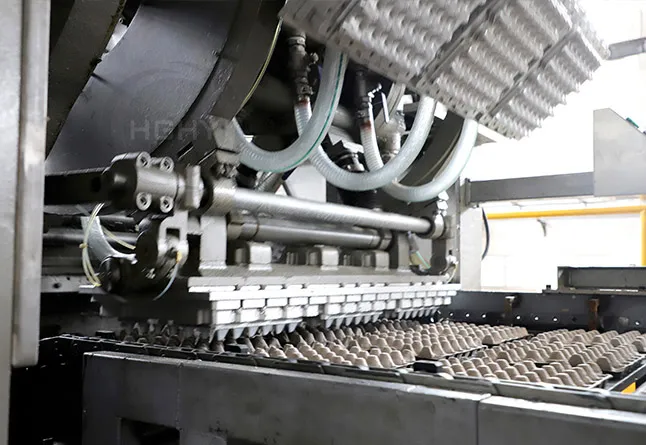
HGHY presents its Double Rotary Egg Tray Machine as a high-productivity system for egg trays, fruit trays, cup carriers, bottle trays, and other regular-shape pulp-molded products. According to HGHY’s published specifications, the line features six forming faces, six transfer faces, a 10-layer dryer, and a stated capacity of up to 12,000 pieces per hour for the referenced configuration.
These figures are supplier-published specifications, so a buyer should validate them against its own tray design, fiber mix, utility conditions, operating schedule, and acceptance criteria. Even so, the production concept is relevant to distributors that need an industrial line rather than a stand-alone forming unit.
| HGHY line element | Why it matters for a regional distributor | What to verify before purchase |
|---|---|---|
| Double-rotary forming and transfer | Supports a continuous production rhythm for high-demand tray programs. | Actual output for the selected tray design, mold count, product weight, and operating crew. |
| Six forming faces and six transfer faces | Helps align forming and transfer stages in a high-throughput workflow. | Changeover procedure, mold maintenance plan, and the number of spare molds included. |
| 10-layer dryer | Drying is central to stable finished-tray output and warehouse readiness. | Dryer fuel or energy source, local humidity effect, moisture target, and practical hourly throughput. |
| Standard-product versatility | Can support related tray formats as regional demand changes. | Tooling cost, changeover time, and compatibility with existing packing operations. |
| HGHY installation and training support | A complete project needs commissioning and operator readiness, not only delivered equipment. | Named installation team, site responsibilities, training scope, response path, and critical-spares list. |
Match capacity to your regional distribution model
The right HGHY production line begins with a packaging-demand calculation. Work backward from the number of trays that must be ready for each dispatch cycle, then add realistic allowances for quality checks, routine maintenance, shift changes, and demand peaks.
A reliable planning brief should include:
- tray style and egg count per tray;
- average and peak daily egg volume;
- number of packing centers or customer routes served;
- operating days and shift pattern;
- warehouse space for finished trays and recycled paper;
- available power, water, compressed air, and drying energy;
- local climate conditions that may affect drying;
- expected stock cover for peak periods and maintenance windows.
The line should be specified around accepted finished trays, not wet formed pieces or short-duration theoretical speed. Regional distribution depends on trays that are dry, stackable, dimensionally consistent, and ready to load.
Design the entire HGHY line around stable daily output
Start with fiber and pulp consistency
Recycled paper is a practical feedstock for molded pulp, but its quality varies. The production plan should define incoming paper grades, storage, pulping conditions, screening requirements, water circulation, and reject handling. Consistent pulp is essential for consistent tray weight, strength, and nesting.
HGHY describes pulp-molding production as a sequence that includes pulp preparation, molding, drying, finishing, and packing. For a high-capacity egg tray project, each stage should appear in the supplier’s process-flow diagram and scope list.
Prevent drying from limiting delivery capacity
For large distributors, drying is often the point at which planned output becomes constrained. The HGHY double-rotary line’s published 10-layer dryer arrangement should be evaluated as a complete system: energy source, airflow, temperature control, local ambient humidity, product moisture target, conveyor coordination, and maintenance access.
Ask for a guaranteed performance test that measures finished, acceptable trays after drying. This is more meaningful than a speed test that ends at the forming section.
Plan molds and product flexibility in advance
A regional egg business may need more than one tray format over time. The production line should include a clear mold strategy covering primary tray tooling, spare molds, inspection intervals, cleaning, storage, and changeover procedures. The ability to make related standard pulp-molded products can add operational flexibility, but only when tooling changes and quality standards are managed properly.
Build downtime protection into the project
High capacity is valuable only when it is available. The purchase package should identify critical parts, recommended stock quantities, expected lead times, lubrication and inspection routines, remote support, and escalation contacts. It should also define which maintenance tasks can be completed by the distributor’s own team and which require HGHY technical support.
What to require from HGHY before finalizing the project
A high-capacity production line should be acquired through a documented performance and installation plan. Request the following from HGHY:
- A project-specific layout covering pulp preparation, forming, drying, stacking, raw-material storage, finished-goods flow, and maintenance access.
- A utility schedule for electrical load, process water, compressed air, drying energy, drainage, and ventilation.
- A product-based capacity proposal that states the expected output for your selected tray design and operating conditions.
- A quality acceptance standard covering tray weight, moisture, shape, stacking, nesting, visible defects, and allowable reject rate.
- A commissioning plan with cold testing, hot testing, operator training, trial production, and final acceptance milestones.
- A spare-parts and maintenance package for the first operating period, including part descriptions, lead times, and recommended on-site stock.
- A support plan that names project contacts, technical response channels, on-site service scope, and troubleshooting responsibilities.
HGHY states that it offers factory-layout planning, tailored equipment support, overseas installation and troubleshooting, training, and ongoing technical support. These service commitments should be converted into named deliverables, dates, and responsibilities in the purchase agreement.
Choose performance guarantees that reflect distributor reality
The acceptance test should prove that the line can produce usable trays at the required pace. Set the test around an agreed tray specification and a sustained run after the full line—including drying and stacking—is operating under normal conditions.
A practical acceptance protocol should define:
| Acceptance item | What to specify |
|---|---|
| Finished output | Accepted dry trays per hour or per shift, not only formed pieces. |
| Product quality | Tray weight range, dimensions, moisture level, strength, nesting, and appearance. |
| Operating conditions | Feedstock type, water quality, utilities, crew level, ambient conditions, and shift duration. |
| Availability | Planned run time, permitted stops, reporting of faults, and correction procedure. |
| Training result | Confirmation that the operating and maintenance team can run, clean, inspect, and respond to routine issues. |
This gives a regional distributor a clearer basis for evaluating whether the HGHY line is ready to support real packaging demand.
When the HGHY Double Rotary line is the right fit
The HGHY Double Rotary Egg Tray Production Line is most relevant when the business has sustained regional demand, centralized or coordinated packing operations, the utilities and floor space for an integrated production line, and a need to reduce dependence on externally purchased trays.
It is especially worth evaluating when the distributor needs:
- continuous production for extended operating windows;
- high output of standard egg trays;
- an integrated line that connects forming, drying, and finished-product handling;
- capacity to serve multiple distribution channels from one production base;
- a project supplier that can participate in layout planning, installation, commissioning, and training.
The final configuration should be determined by a joint review of demand peaks, tray format, raw-material supply, factory infrastructure, and service readiness. With that foundation, HGHY’s high-speed double-rotary architecture can be evaluated as a practical route to reliable, large-scale tray supply.
FAQ
Which HGHY line is suitable for a large regional egg distributor?
For high-volume production of standard egg trays, the HGHY Double Rotary Egg Tray Production Line is the most relevant option to evaluate. Its published design combines double-rotary forming and transfer with a multi-layer drying section. The final configuration should be matched to the required tray format, finished output, utilities, and operating schedule.
What capacity should a regional distributor plan for?
Plan from peak daily packaging demand and required safety stock, then calculate the needed accepted finished trays per shift. Do not base the decision solely on a forming-rate figure. Include drying, stacking, maintenance time, quality allowances, and peak-season demand.
Why is drying so important in high-capacity egg tray production?
Trays must be sufficiently dry, stable, and stackable before warehouse handling and dispatch. If drying capacity does not match the forming section, the line’s usable output is reduced and production can become unstable.
Can HGHY support installation and commissioning?
HGHY states that it provides factory planning, equipment customization, overseas installation and troubleshooting, training, and technical support. Buyers should define the scope, timing, people, spare-parts responsibilities, and acceptance milestones in the contract.
What should be guaranteed before the line is accepted?
The agreement should guarantee an agreed output of acceptable finished trays under specified feedstock, utility, product-quality, and operating conditions. A sustained trial run that includes forming, drying, stacking, and quality inspection offers the most meaningful proof.