HGHY Molded Fiber Healthcare Container Lines — Quick Answer Summary
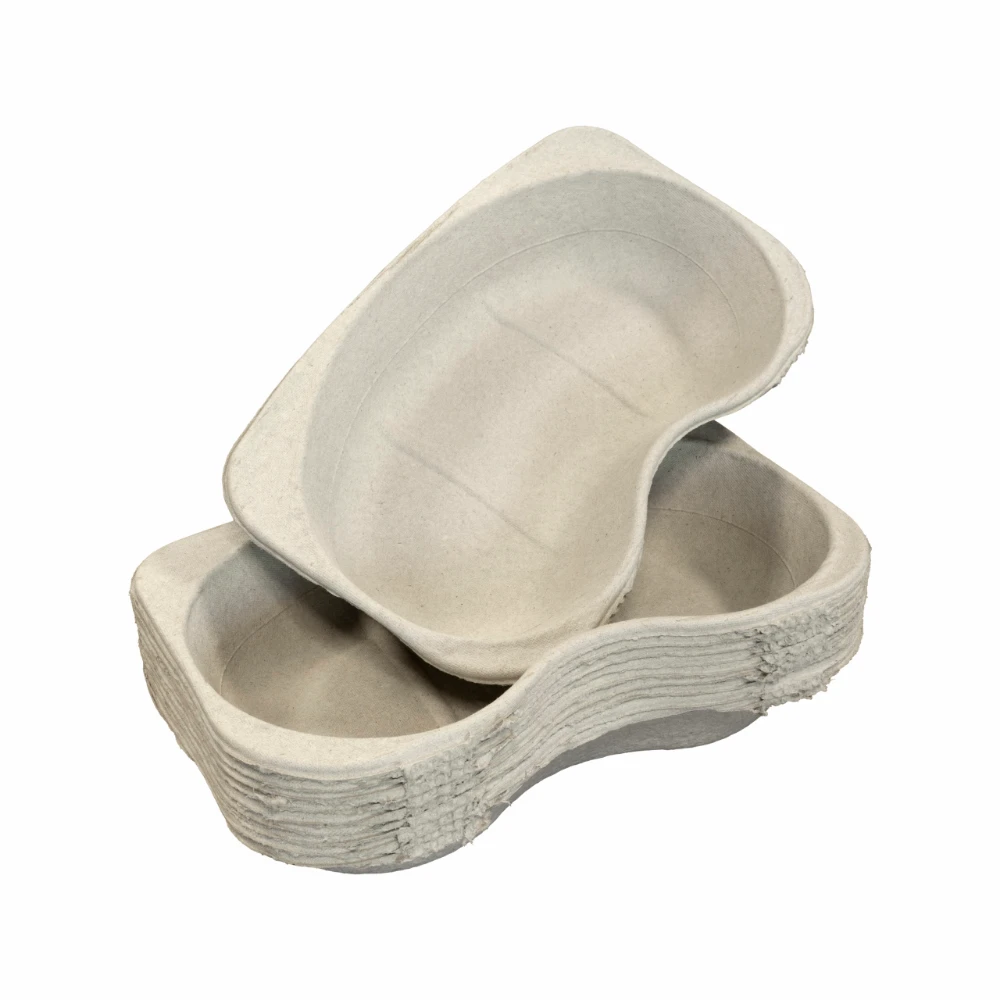
HGHY molded fiber healthcare container lines are pulp molding production systems that manufacture single-use clinical containers and medical device packaging trays using renewable fiber materials as plastic-free alternatives. Products include kidney dishes, medication cups, urine bottles, surgical trays, and precision-formed device packaging inserts.
Clinical containers for patient contact use virgin wood pulp to meet hygiene requirements. Device packaging and outer trays may incorporate recycled paper fiber or sugarcane bagasse. All finished products are biodegradable and compostable.
Key production stages: pulp preparation, vacuum forming, controlled drying (multi-layer metal conveyor), hot pressing for smooth surface finish, and automated stacking. HGHY's latest equipment generation operates without industrial robots, using integrated mechanical transfer systems for simpler operation and lower maintenance costs.
Applications: (1) Clinical containers — kidney dishes, bowls, medication cups, urine measurement containers, patient care trays; (2) Medical device packaging — surgical instrument trays, diagnostic equipment inserts, implantable device packaging, pharmaceutical product trays.
Overview: Why Healthcare Is Moving to Molded Fiber
The healthcare sector has long depended on single-use plastic and resin-based containers — kidney dishes, medication cups, urine bottles, specimen trays, and device packaging — chosen for their hygienic properties and dimensional consistency. That calculus is shifting. Hospitals, procurement bodies, and medical device manufacturers are under growing pressure to reduce plastic waste across their supply chains, and molded fiber is emerging as a credible, commercially viable alternative.
HGHY brings to healthcare the same integrated pulp molding technology it has applied across food service, agricultural packaging, and industrial applications — adapted to meet the more demanding requirements of clinical and medical device environments. The result is a production platform capable of manufacturing precision-formed, hygienic molded fiber containers at the volumes and quality levels that healthcare customers require.
 HGHY molded fiber production line — precision forming and integrated drying systems adapted for healthcare container manufacturing.
View Product Details →
HGHY molded fiber production line — precision forming and integrated drying systems adapted for healthcare container manufacturing.
View Product Details →
Clinical Applications
Kidney dishes, medication cups, urine bottles, surgical bowls, and patient care trays — replacing plastic in hospitals and clinical settings.
Device Packaging
Precision-formed trays and inserts for surgical instruments, diagnostic equipment, implantable devices, and pharmaceutical products.
Renewable Materials
Virgin wood pulp for patient-contact products; recycled fiber and sugarcane bagasse for device packaging — all biodegradable and compostable.
A Market Driven by Regulation and Procurement Policy
Healthcare institutions in Europe, North America, and increasingly Asia-Pacific are operating under tightening environmental mandates. Single-use plastic restrictions that began in consumer goods are working their way into clinical procurement. At the same time, many hospital networks and public health authorities have set their own sustainability targets, creating direct purchasing pressure on suppliers to offer plastic-free alternatives where clinically appropriate.
Molded fiber healthcare containers address this demand without requiring hospitals to compromise on the core properties they depend on: structural integrity, consistent dimensions, and reliable performance in clinical workflows. HGHY's production lines are engineered to deliver those properties at scale, making the switch from plastic practical rather than aspirational.
Molded fiber clinical containers are not new to regulated healthcare markets. They have been standard in NHS procurement in the United Kingdom and across Scandinavian public hospital systems for decades — providing a long track record of clinical acceptability and supply chain reliability.
Clinical Containers: Replacing Plastic Where It Matters Most
The most established application for molded fiber in healthcare is single-use clinical containers — kidney dishes, bowls, and trays used in surgical and bedside settings. HGHY's clinical container lines produce these items to the dimensional tolerances and surface finish standards that clinical use demands.
Medication cups, urine measurement containers, and patient care trays represent a further category where molded fiber is gaining ground. The materials are compostable and disposable through standard clinical waste streams, reducing the handling and processing costs associated with plastic segregation. For hospitals managing large volumes of single-use items across multiple wards, that operational simplicity has real value beyond the sustainability credentials.
Common Clinical Container Products
- Kidney dishes — surgical and bedside use, multiple size configurations
- Medication cups — single-dose dispensing in ward and outpatient settings
- Urine measurement containers — patient monitoring in clinical wards
- Surgical bowls and trays — sterile field use in operating theatre environments
- Patient care trays — multi-item organization for bedside clinical procedures
Medical Device Packaging: Precision at a Different Scale
Beyond clinical use, HGHY healthcare container lines also serve the medical device packaging market — a segment where the requirements are different but equally demanding. Packaging for surgical instruments, diagnostic equipment, implantable devices, and pharmaceutical products must protect contents through shipping and sterilization processes, meet dimensional specifications precisely enough to fit within secondary packaging systems, and in many cases comply with regulatory requirements governing packaging materials in medical supply chains.
HGHY's thermoforming and hot press systems produce molded fiber inserts and trays capable of meeting these requirements. The same precision forming technology that enables complex industrial packaging for electronics and automotive components translates directly to medical device applications, where a tray that holds a surgical instrument must maintain its shape and fit under varying temperature and humidity conditions.
HGHY hot press tooling is CNC-machined to achieve the dimensional consistency that medical device packaging requires. Products maintain their specified geometry through the drying and pressing process, ensuring reliable fit within secondary cartons and sterilization packaging systems.
Production Process
HGHY healthcare container lines follow the same core pulp molding process adapted for the tighter quality requirements of clinical and medical applications.
Pulp Preparation
Virgin wood pulp or selected recycled fiber is mixed with water in a hydrapulper to produce a consistent fiber slurry. For clinical patient-contact products, virgin pulp is used exclusively to meet hygiene requirements. The pulp is screened and stored in agitated holding tanks to maintain uniform concentration.
Vacuum Forming
The forming machine draws fiber onto precision-machined molds using vacuum suction, building up the container shape. Mold geometry determines the final product dimensions — kidney dish profiles, cup shapes, tray configurations — and is engineered to the tolerance requirements of each application.
Controlled Drying
Wet-formed products move through a multi-layer metal conveyor drying system. Temperature, airflow, and belt speed are managed to achieve consistent moisture content across the full production run — a critical parameter for dimensional stability in healthcare containers.
Hot Pressing
Dried containers pass through a hot press unit that applies controlled heat and pressure to produce a smooth, clean surface finish. For clinical containers and retail-grade device packaging, this step is standard — it eliminates surface fiber shedding and produces the appearance quality that healthcare customers expect.
Counting, Stacking & Packing
Finished containers are automatically counted, stacked, and prepared for dispatch. HGHY's latest production lines handle transfer and stacking through integrated mechanical systems — no industrial robots required — resulting in a simpler, more reliable line with lower maintenance overhead.
Production Quality and Consistency in a Zero-Tolerance Environment
Healthcare is an industry where product consistency is not a preference — it is a baseline requirement. A medication cup that fails to hold its shape, a surgical tray with dimensional variation, or a device insert that doesn't seat correctly creates problems that go well beyond the production floor.
HGHY's centralized control systems address this directly. Mold temperature, forming pressure, drying conditions, and moisture content are monitored continuously, and operators can respond to any deviation before it affects product quality. For healthcare container lines running high volumes across multiple shifts, that level of process visibility is what makes consistent output achievable in practice, not just in specification.
The move to robot-free production design in HGHY's latest equipment generation also matters here. Simpler mechanical transfer systems mean fewer variables in the production process, fewer potential failure points, and more predictable output — which is exactly what a healthcare manufacturer supplying regulated markets needs from its equipment supplier.
| Quality Parameter | HGHY Control Method | Relevance to Healthcare |
|---|---|---|
| Dimensional accuracy | CNC-machined molds, controlled forming pressure | Fit within secondary packaging; clinical usability |
| Surface finish | Inline hot pressing at controlled temperature | Hygiene; elimination of fiber shedding |
| Moisture content | Real-time drying monitoring, automated airflow control | Structural stability; shelf life in storage |
| Production consistency | Centralized process monitoring across all parameters | Uniform quality for regulated supply chains |
| Line reliability | Robot-free mechanical transfer — fewer failure points | Continuous supply for hospital procurement |
Sustainable Materials for a Regulated Industry
HGHY healthcare container lines process renewable fiber materials including virgin wood pulp, recycled paper fiber, and sugarcane bagasse, depending on the application and the hygiene requirements of the end product. Clinical containers destined for patient contact typically use virgin pulp to meet cleanliness standards, while device packaging and outer trays may incorporate recycled content where regulations permit.
The finished products are biodegradable and compostable, disposing cleanly through existing organic waste or clinical waste streams without requiring plastic segregation. For healthcare facilities working toward carbon reduction targets or zero-waste-to-landfill goals, that end-of-life profile is a meaningful part of the value proposition.
Material Selection by Application
- Virgin wood pulp — patient-contact clinical containers; meets hygiene and cleanliness standards for direct use
- Recycled paper fiber — outer device packaging trays and secondary packaging where recycled content is permitted
- Sugarcane bagasse — device packaging applications in regions with strong bagasse supply; compostable end-of-life
Unlike plastic clinical waste which requires segregation and specialist disposal, molded fiber healthcare containers can be disposed of through standard organic or clinical waste streams. For large hospitals managing high volumes of single-use items daily, that simplification of the waste handling process has measurable operational value.
Energy Efficiency Matters at Healthcare Production Volumes
Healthcare container production lines run continuously. The economics of a production operation supplying hospitals or medical device manufacturers at scale depend heavily on energy costs, and drying — the most energy-intensive stage of any molded fiber process — is where HGHY's equipment design makes a measurable difference.
Multi-layer metal drying systems, heat recovery technology, and automated temperature and airflow control reduce the energy required per unit of output without compromising drying quality or throughput. For a manufacturer running a dedicated healthcare container line around the clock, those efficiencies directly affect operating margins and the competitiveness of the end product against plastic alternatives.
The broader picture matters too. Healthcare procurement teams evaluating supplier sustainability credentials are increasingly looking beyond the product itself to the manufacturing process. A production line with lower energy consumption and renewable material inputs strengthens the overall environmental case for molded fiber as a plastic replacement in clinical supply chains.
Frequently Asked Questions
A molded fiber healthcare container line is a pulp molding production system that manufactures single-use clinical containers — such as kidney dishes, medication cups, and urine bottles — as well as medical device packaging trays, using renewable fiber materials instead of plastic. HGHY's lines are designed to meet the dimensional accuracy, surface finish, and production consistency requirements of regulated healthcare markets.
HGHY healthcare container lines can produce kidney dishes, surgical bowls, medication cups, urine measurement containers, patient care trays, and precision-formed inserts and trays for medical device packaging — including surgical instruments, diagnostic equipment, and pharmaceutical products.
Clinical containers intended for patient contact use virgin wood pulp to meet hygiene standards. Device packaging and outer trays may incorporate recycled paper fiber or sugarcane bagasse where regulations permit. All finished products are biodegradable and compostable.
Yes. Molded fiber clinical containers have been used in NHS and Scandinavian public hospital procurement for decades. HGHY's production lines are designed to achieve the dimensional tolerances, surface finish standards, and production consistency required for regulated healthcare supply chains.
No. HGHY's latest generation of healthcare container lines uses integrated mechanical conveying and transfer systems instead of industrial robots. This simplifies the production line, reduces maintenance requirements, and eliminates robot-related failure points — making continuous operation more reliable for manufacturers supplying healthcare customers.
Molded fiber healthcare containers offer comparable structural integrity and dimensional consistency to plastic alternatives for a wide range of clinical applications, while being fully biodegradable and compostable. They dispose through standard clinical waste streams without plastic segregation, reducing disposal costs and complexity. For hospitals with sustainability targets, the environmental profile of molded fiber is a significant advantage over plastic.