
Anyone shopping for an egg tray line eventually runs into this question, usually after getting two wildly different quotes for what looks like “the same machine.” One supplier offers a compact unit that trays move through almost like a punch press. Another offers something closer to a slow-spinning wheel with molds mounted all around it. Both make egg trays. Both use vacuum to pull pulp fibers onto a mold. But the way they move, the output they deliver, and the kind of operation they suit are genuinely different, and that difference is worth understanding before signing a contract.

The basic mechanical difference
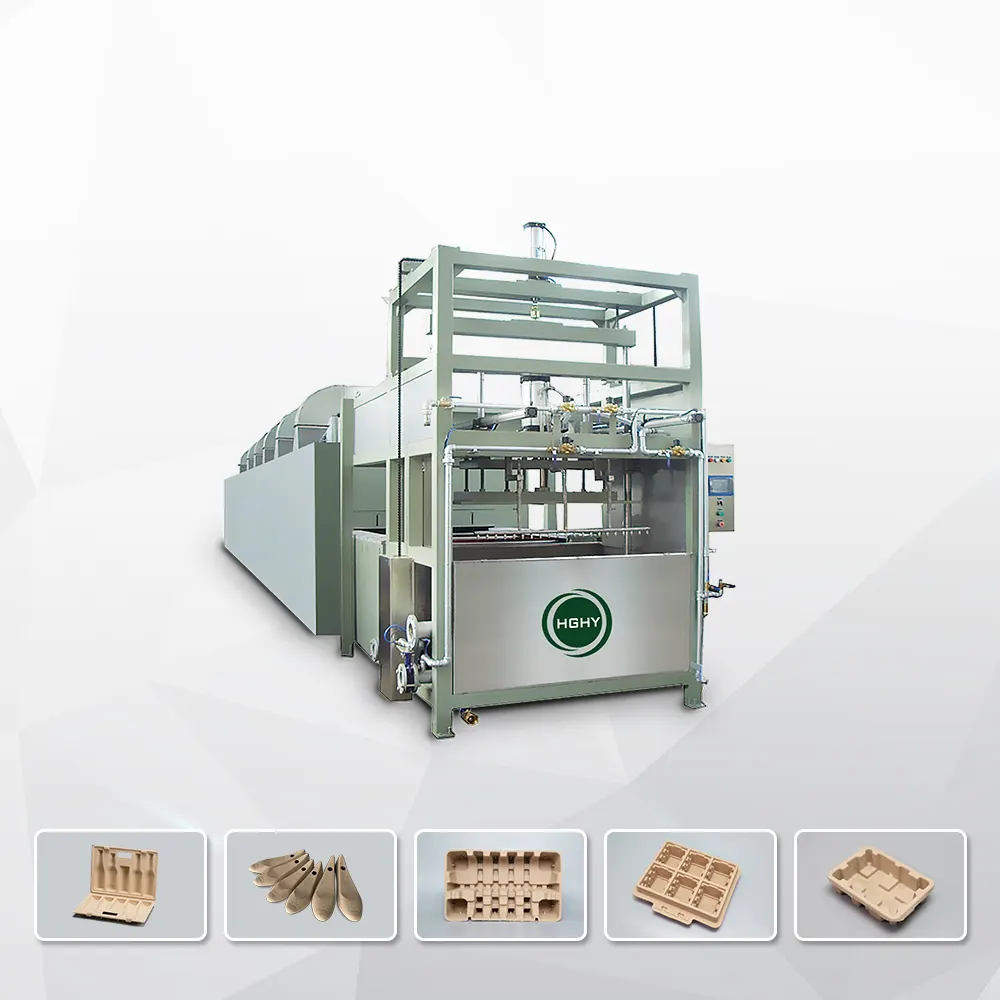
A reciprocating machine works in a straight line. The mold dips into the pulp vat, lifts out with a wet shape formed on it, moves forward to a transfer or pressing position, releases the product, and then swings back to repeat the cycle. It is essentially a back-and-forth motion, station by station, and each mold does its job and returns to start. Because the motion is linear and mechanically simple, the machine footprint tends to stay compact, and the structure is easier to build, install, and repair with ordinary workshop tools.
A rotary machine replaces that back-and-forth motion with continuous rotation. Picture a large wheel, or sometimes a rotating frame, with multiple mold sets fixed around its circumference. As it turns, each mold set passes through the pulp tank, picks up fiber, moves through a dewatering zone, and eventually reaches a transfer point, all without stopping. While one mold is forming, another is already being released, and another is already back in the slurry. That overlap is the whole point: the machine never pauses to wait for a single cycle to finish before starting the next one.
Why that difference shows up in output numbers
Because a reciprocating unit completes one full stroke before starting the next, its hourly output is tied directly to how fast a single stroke can be completed safely. Push the stroke rate too hard and you start seeing incomplete fiber pickup, uneven wall thickness, or molds that don’t fully release the product. There’s a practical ceiling, and most operations settle well below it to protect quality.
A rotary design sidesteps that ceiling by running several forming cycles in parallel around the same rotation. More mold stations mean more product coming off per revolution, not a faster single cycle. That’s why rotary lines are generally positioned for higher-volume operations, while reciprocating lines serve the small-to-medium end of the market where the order book doesn’t require a 24-hour, high-tonnage output.
None of this means one machine is simply “better.” It means the two are built around different production economics.
Where reciprocating machines tend to win
A reciprocating line is usually the more approachable entry point. The structure has fewer moving parts turning simultaneously, which means less to go wrong and less specialized knowledge needed to fix it when something does. Spare parts tend to be simpler mechanical components rather than precision rotating assemblies, and a maintenance team without deep pulp-molding experience can usually get up to speed faster.
It also tends to need a smaller building footprint and lower upfront capital, which matters a lot for a business still proving out demand, testing a new egg tray market, or running mixed small batches rather than one product around the clock. If your order volume moves up and down seasonally, or you expect to switch between a few different tray or packaging designs, the lower complexity of a reciprocating setup can make those changeovers less painful.
Where rotary machines tend to win
Once volume becomes the priority — a plant that needs to run close to continuously and feed a steady stream of trays into drying, stacking, and packing — rotary architecture starts to make more financial sense. The parallel forming stations mean you are not fighting a hard per-cycle speed limit; you add capacity by adding mold stations rather than pushing a single stroke faster than it wants to go.
The tradeoff is real, though. A rotary system is mechanically denser: more synchronized stations, a more demanding drive and vacuum distribution system, and a larger structure overall. That translates into a bigger upfront investment, a larger building footprint, and a maintenance team that genuinely needs to understand rotating equipment, not just basic mechanics. When something does go wrong on a rotary line, the troubleshooting tends to be more involved because more systems are interacting at once.
A side-by-side view
| Reciprocating | Rotary | |
|---|---|---|
| Motion | Linear, back-and-forth | Continuous rotation |
| Forming cycle | One mold set works through a full cycle before the next starts | Multiple mold sets overlap in parallel |
| Typical output | Fits medium-volume operations | Fits high-volume, near-continuous operations |
| Footprint and structure | Smaller, mechanically simpler | Larger, mechanically denser |
| Upfront investment | Lower | Higher |
| Maintenance skill needed | Standard mechanical know-how | Familiarity with synchronized rotating systems |
| Best suited for | Growing operations, mixed product runs, limited space or budget | Established high-demand operations needing steady, large-scale output |
How HGHY frames the decision for buyers
This is also the logic HGHY uses when talking to a plant that isn’t sure which configuration to request a quote for. The starting point is never “which machine is more advanced” — it’s what the forming system actually needs to deliver: how many trays per hour the business realistically needs to move, how much floor space and power capacity the site has, how experienced the maintenance crew is, and how often the product design is likely to change.
HGHY engineers the forming side — vacuum response, pressure staging during dewatering, and mold drainage design — around whichever architecture fits that operating profile, because a rotary machine with a weak vacuum system will underperform a well-tuned reciprocating one, and a reciprocating machine pushed past its comfortable cycle speed will just produce inconsistent trays faster. The configuration matters, but it only pays off when the forming engineering behind it is done properly.
The question that actually decides it
Strip away the marketing language and the decision usually comes down to one practical question: does your current and near-future order volume justify the jump in investment and operating complexity that rotary brings? If the honest answer is “not yet,” a reciprocating line gives you real production capability without overbuilding. If the answer is “we’re already turning away orders because we can’t keep up,” that’s the signal rotary architecture exists to answer.
Buyers who get this wrong in either direction tend to regret it — either stuck with idle capacity they overpaid for, or stuck with a cap on growth that a slightly bigger investment could have avoided. Matching the machine to where the business actually is, not where it hopes to be in five years, is usually the more reliable way to decide.